



I found out yesterday that Dire Straits frontman Mark Knopfler was a journalist, and I am frankly a little pissed off that nobody told me this sooner.
There are certain pieces of information that arrive in your life masquerading as trivia and then proceed to rearrange the furniture. This was one of them. Dire Straits was one of the first bands I ever loved. Not one of the first bands I discovered as a teenager, when discovering music becomes an intentional act, and you start constructing an identity out of SPIN Magazine articles and a collection of band shirts cultivated from the local Hot Topic. I mean, the first. I was born in 1984, and some of my earliest memories are of sitting on the floor with my dad while Dire Straits played through speakers that were bigger than my entire body.
I can still see the living room. There was one of those enormous 1980s entertainment centers, back when televisions were pieces of furniture substantial enough to kill you in an earthquake. I remember the wood-grain paneling and the giant speakers, all of it bumped up against a wall lined with shelves holding my dad’s books, police memorabilia, and the terrarium where his leopard gecko, Margo, lived, nonchalantly perched on a rock under a heat lamp, giving exactly zero shits. I can remember the physical sensation of being there, sitting on the floor, thumbing through a 1970s pea-green album case and looking up. Listening. My dad would sing the songs to me, and he wanted me to listen to the words.
This matters.
Because one of the songs I was particularly fascinated by was Money for Nothing, a completely reasonable song for a preschool-aged child to contemplate deeply. I didn’t understand all of it, obviously. I knew there were microwave ovens and color TVs involved, and that somebody was very angry about somebody else getting money for nothing. I knew Sting, that one guy from The Police my mom thought was “a babe,” suddenly appeared, demanding his MTV. Mostly, though, I understood that this wasn’t just a song. Someone was talking. There was a story happening inside it.
Dire Straits’ “Money for Nothing” video, an early cornerstone of my musical education and a completely normal thing for a preschooler to study this intently.
And when my dad told me to listen to the words, I took the assignment extremely seriously. I studied the liner notes inside the cassette. I wanted to know what Mark Knopfler was actually saying, which eventually created a problem because my dad did not always know what Mark Knopfler was actually saying.
One day he was singing along and got to the line about the appliance store: “We got some movies, refrigerators—”
I corrected him. “No,” I told him, “that’s not what it says. ‘We’ve got to move these refrigerators.’” Because, obviously, I had read the source material.
I remember my dad being genuinely taken aback. Maybe even offended. This was his music. He had introduced it to me. He was the person teaching me the song, and now the tiny child sitting on his floor had apparently conducted independent research and returned with corrections.
It would not be the last time this happened. He loved introducing me to things, and he loved when I became interested in them too. But sometimes I would become really interested—I would study it, learn everything I could, get good at it, and occasionally, get better at it than he was. That’s when the enthusiasm could turn almost territorial. Hey. That’s my thing. Which was unfortunate, because telling me something is interesting has historically been a very dangerous thing to do.
I might come back with sources.
Still, there was something genuinely wonderful about being invited into his world, and Dire Straits was only part of it. My dad had this wonderfully random collection of records and recordings he would pull out and show me: audio of the moon landing, The Star-Spangled Banner, Cheech Marin’s Earache My Eye. I was completely transfixed by that one—the title, the cover, the sheer absurdity of the whole thing. My dad told me he liked it because it was so ridiculous that he simply had to have it.
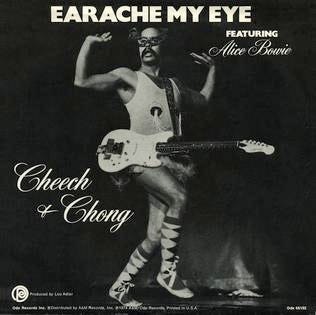
I would eventually spend an unreasonable percentage of my life making parody songs and poems about things that probably did not need little ditties written about them. I’ve also realized as an adult that this is one of the ways I understand love. Show me the weird thing you know too much about. Play me the record and tell me the backstory. Explain the obscure thing that has fascinated you for twenty years. I love people’s nerdisms. I want to understand why you think something is interesting. My dad did that for me when I was little, and one of the things he gave me was Dire Straits.
About ten years later, courtesy of the educational afterschool programming that was VH1’s Pop Up Video series, I learned where Money for Nothing actually came from. Mark Knopfler was in an appliance store in New York. A wall of televisions was tuned to MTV, which was still a relatively new cultural phenomenon, and a delivery worker standing nearby began providing his unsolicited review of the musicians on the screens. Knopfler realized almost immediately that the guy’s commentary was better than anything he could conjure. He got a pen and paper, sat down in a kitchen display in the store’s front window, and started writing the man’s words down.
That became Money for Nothing. The voice in the song, the resentment, the insults, the disbelief that these ridiculous people on television were becoming millionaires while ordinary guys were hauling appliances around, all came from the character Knopfler found standing there. He walked into a room full of General Electric’s finest wares and walked out with one of the most iconic anthems of the decade.
I’ve always loved that story because I wholly relate to the impulse.
I once fell asleep with the television on during a particularly dull episode of Grey’s Anatomy and woke up during The Golden Bachelorette. I had never watched The Bachelor universe in any capacity and felt rather proud of that accomplishment. I don’t know the rules. I don’t know why everyone is always crying near a hot tub. But I opened my eyes to discover an elderly man with a tremor performing a ribbon dance in what appeared to be some kind of bachelorette beauty pageant for men. I became instantly transfixed.
What the fuck is this shit?

So naturally, I wrote a song about it. Because why wouldn’t you want a musical number to accompany something that batshit insane?
This is what I do. Something completely mundane happens, and my brain puts a little box around it. Most people experience these things and go on about their lives. My brain goes, Wait. There’s something in that. Then yesterday, driving with Spotify on, Dire Straits’ Lady Writer came on. I’ve loved that song forever, partly because I am, conveniently, a lady writer. For reasons I can’t explain, after listening to it for decades, I suddenly wondered: Who actually was the lady writer?
So I looked it up. She’s simply some woman Mark Knopfler saw on television.
That’s the whole riveting story. She didn’t have to be historically significant or even particularly interesting. He noticed her, and that was enough to earn her a song. I found that delightful. Here I was, a lady writer who had spent most of her life listening to Lady Writer, only to finally investigate said lady writer and discover that Knopfler had apparently done what I do all the time: noticed some random person on a screen and decided there was something there. Knopfler later explained that around that period of his songwriting, he was beginning to realize he could write about anything. Songs didn’t have to be about some predetermined category of “Important Things.” If something caught his attention, that was enough to pick up a pen.
When I read that, I instantly thought, “Mark, bro. Same.”
Then I kept reading, and I learned that before Dire Straits, Mark Knopfler was a journalist.
I audibly shouted at my screen: “Are you for real right now?!”
Before he was a rock star, Knopfler worked as a reporter for the Yorkshire Evening Post. Journalism taught him to observe, organize, and condense—to look at ordinary life, figure out where the story was, and get rid of everything that wasn’t the story. He has talked about journalism as part of what shaped him as a songwriter, teaching him how to take real life and find the few lines that tell the story.
And suddenly I was back on the brown shag carpet of the living room floor. I could seemingly feel it. The wood grain. The giant speakers. The books. The police memorabilia. Margo in her terrarium, gnawing on a mealworm. That ridiculous enormous television. Me, tiny enough that all of it towered over me, sitting there listening while my dad sang along with a former newspaper reporter who built songs out of things he noticed.
My dad and I do not have a relationship today.
That sentence could open an entirely different essay, and in some ways it opens this one too. My relationship with him caused me a tremendous amount of pain. I don’t need to soften that with age, nostalgia, or the cultural insistence that every complicated parent-child story eventually becomes a redemption story. Sometimes distance is the healthy ending, and I’ve learned that understanding somebody better doesn’t make you want them back in your life. I am not particularly interested in rehabilitating my father. I am, however, deeply interested in understanding myself.
And there are these strange little pockets in my childhood where I can see that he recognized something in me before I had any language for it myself. He intentionally let me stay up late on Saturday nights to watch Saturday Night Live because he thought I would like it. Not because it was children’s programming—it very much was not—but because something about my little developing personality apparently made him think, She needs to see this.
He was right.
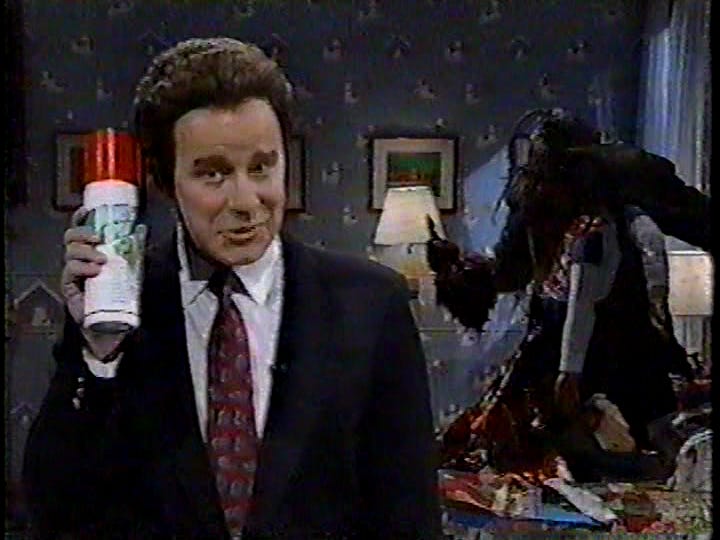
SNL changed the architecture of my brain. Comedy became a language I understood instinctively, and eventually one I wanted to write myself. Satire, sketches, parody, absurdity, the ability to look at something everyone else accepts as normal and tilt it three degrees until suddenly everyone can see how fucking weird it is—that became part of how I process the world. But now I realize he had started showing me how to do that even earlier. Here’s this ridiculous Cheech & Chong record. You need to see this. Here’s Dire Straits. Listen to what this guy is saying. Eventually: Here’s Saturday Night Live. Stay up. I think you’re going to like this. He was sharing his world with me, and I was doing what I apparently always do when somebody shares their world with me: paying very close attention.
That is one of the difficult things about having a complicated relationship with a parent. We want the accounting to be cleaner than it is. If someone hurt you badly enough that you eventually had to remove them from your life, it would be much more convenient if everything they ever gave you could be placed neatly on the same side of the ledger.
Mine can’t. It’s a bookkeeper’s nightmare.
My dad caused damage that I have spent a lifetime trying to understand. He also showed a weird little girl things he thought she would find interesting, and sometimes he was spectacularly right. One does not acquit the other, and acknowledging the good does not require me to reconsider the distance between us. It only means I don’t have to surrender things that became part of me simply because I no longer want a relationship with the person who first put them in my hands.
Maybe that’s why finding out Mark Knopfler was a journalist rearranged the furniture. It gave me a new way to look at one of those memories without asking it to become anything more than it was. My dad was just a dad playing music he loved for his little girl, and I was a little girl who took him very seriously when he told me to listen.
I became the person who hears something ridiculous in an appliance store—or sees its modern equivalent playing on The Golden Bachelorette—and immediately starts wondering what I can make out of it. My dad didn’t give me all of that, and Mark Knopfler certainly didn’t. But I can look backward now and recognize some of the places where the pieces first landed. Something good survived a relationship that didn’t. What happened after that belongs to me.
For almost my entire life, I thought Money for Nothing was one of the first songs my dad taught me. Now I know it was written by a former journalist who walked into an appliance store, paid attention to some random guy talking, and realized there was something there. Somewhere along the way, I learned to do the same thing: take the random line somebody said, the comment that hurt, the weird interaction with a stranger at Target, the thing that made me laugh, or the artifact somebody showed me forty years ago that I still haven’t stopped thinking about, and make something out of it.
Money for something.