



I have recently come to the horrifying realization that most of my management philosophy comes from Dewey Finn, a man who stole his roommate’s identity, fraudulently infiltrated an elementary school and kidnapped an entire classroom of children so they could compete in Battle of the Bands.
In my defense, those kids frickin’ rocked.
For anyone who somehow missed School of Rock, the 2003 comedy stars Jack Black as a broke, recently ousted guitarist who impersonates his substitute-teacher roommate for the paycheck, then discovers his painfully well-behaved students can play instruments and secretly turns the class into a rock band. What begins as a deeply illegal attempt to use students as free child labor/backup musicians turns into something unexpectedly sweet: Dewey figures out what each kid is good at, gives them a role that matters, and gets a bunch of insecure little weirdos to see themselves differently.
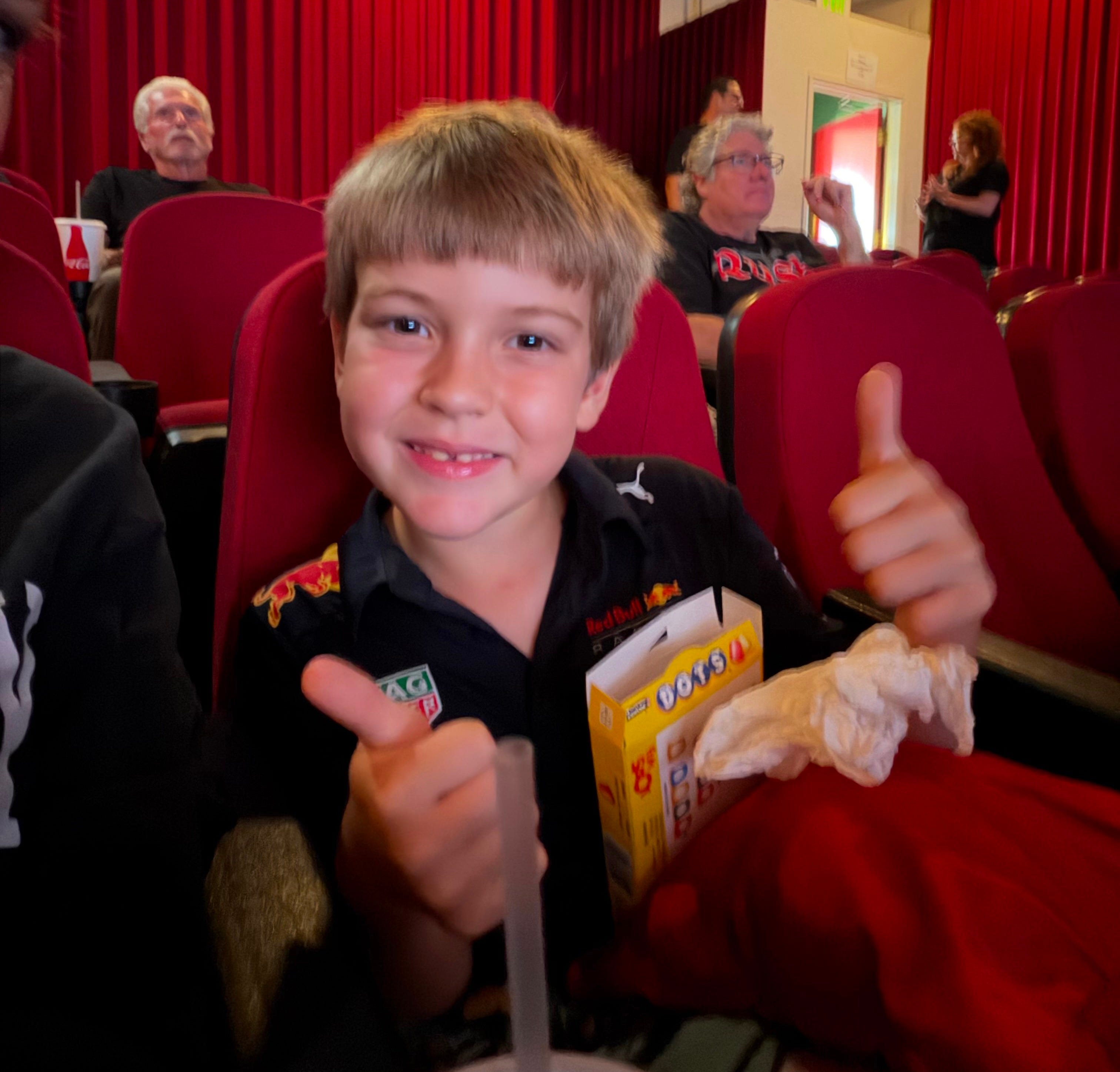
I realized how much I identified with that while rewatching School of Rock at the Palm Theater with our local Monday Night Movie Club, shortly after starting a human resources class for the first time. I took HR because I’ve supervised a lot of people over the course of my career and figured I should probably put some academic theory behind the management style I’ve smushed together through twenty-something years of trial, error, retail trauma, cheerleading, and occasionally telling grown adults to please stop doing an elaborate watercolor painting while on company time. Yes, she set up an easel at her desk and everything!
The timing is almost too perfect. I’m finally studying Human Resources at precisely the moment we seem hellbent on removing as many humans as technologically possible. Which has made me wonder what the human part is actually for.
Dewey, for all his chaos and deeply questionable employment practices, understands one thing instinctively: people are not interchangeable. He doesn’t walk into the classroom and rank the kids from most to least talented. He starts casting. Zack can play guitar and write music. Freddy belongs behind the drums. Lawrence can play keyboards but needs somebody to convince him he’s cool. Tomika barely speaks but has a gigantic voice. Billy thinks your outfit is a tragedy. Summer is such an aggressive little Type-A overachiever that Dewey essentially says, congratulations, tiny tyrant, you’re management. Even the kids who aren’t musicians get jobs.
This is also roughly how I manage, minus the felonies.
I’m autistic and ADHD, vaguely Type B despite being extremely ambitious, frequently running late and spectacularly good in a crisis, partly because I have accumulated decades of experience creating crises for myself and then escaping them. I don’t know where my credit cards are. I’m covered in tattoos and glitter. I have a fat mouth. I don’t necessarily walk into a room looking like the human embodiment of Corporate Leadership, but I know my shit and have a résumé that looks like a Cheesecake Factory menu to back it up. Pages and pages of stuff, none of it seemingly relating to the other, but still somehow hitting the spot.
And I am deliciously good at casting.
When I helped assemble the team for SLO County News, I knew we needed a visual arts magician and I knew exactly who I wanted: Trisha Butcher. Of course she was talented, but that wasn’t what made the decision obvious to me. I had worked adjacent to her before. I had observed that she was kind and sweet and wore her heart on her sleeve. People would feel confident getting important information from someone with her aura. She gave a shit. She was also fun and spicy and had the thick skin required for the particular shitshow we were producing. Her photography was enchanting, and I could see how our platform might give her more room to run with it. We needed what she had, and we had something she could use.
There was another part I didn’t say much about at the time: I suspected my own time there was limited, and I was looking for my eventual replacement to be the lead singer of the band. I wanted my replacement to be better than me. And, Jesus Christ, did I succeed.
That might be one of Dewey Finn’s most underrated leadership qualities. This man has an ego the size of my thunder thighs, but when Zack writes a better song, Dewey recognizes that the kid has the goods. The band stops being a collection of children assembled to make Dewey look like a rock star, and he becomes invested in making them rock stars. If everybody you hire needs to remain slightly less impressive than you so you can continue feeling important, you haven’t built a team. You’ve assembled a tribute band.
Cheerleading taught me the same lesson in a much more literal ensemble. You get every variety of personality, body type, confidence level and learning style, and somehow all those people have to hit the same eight-count. I once coached a girl who was newer to cheer, seemingly forced into it by a very overbearing stage-mom type of parent. She clearly didn’t have the confidence some of the other girls did and seemed to carry some impostor syndrome into the gym. Except I knew that outside of cheer, this same kid could stand in front of the Future Farmers of America, lead people and sheep, and not take anybody’s shit.
So my question was basically: Where the heck is that girl? You can Boss Babe over there on the farm. I have seen you do it! You tried out just like everybody else, and you made this team just like everyone else. This wasn’t a Make-a-Wish situation where we gave you a sympathy spot on this team. You belong here. Act like it.
She eventually became captain and went on to cheer in college.
I didn’t put leadership into her. It was already there. I just happened to know enough of her story to recognize that she had apparently left it on a hay bale back at the barn.
That’s the part of management I’ve always loved most: figuring people out. Walmart, of all places, taught me the phrase “management by walking around,” which is corporate language for the revolutionary concept of getting out of your ivory tower and actually engaging with the people of The Store. Walmart was one of the greatest crash courses in human sociology and biohazard management I’ve ever received. You learn very quickly that fairness does not mean speaking to everybody exactly the same way. Some employees wanted direct feedback: tell me what I’m doing wrong, tell me how to fix it, and then, please leave me the fuck alone. Honestly, I respect that. Others needed more explanation, reassurance, and a true human experience. Same expectations, different route there.
Every team needs a Billy to prevent your organization from becoming its own worst enemy and making critical fashion errors. Sometimes “You’re tacky and I hate you” is constructive feedback.
The trick is knowing when someone needs a Dewey Finn pep talk and when someone needs Principal Mullins to show up with a furrowed brow. I’ve been told that I struggle with that second one. I much prefer to arrive with Stevie Nicks playing in the background. A former boss once told me I see so much potential in people that I give them too many chances. Because she managed by walking around, she got to see me in the wild and notice something I couldn’t see in myself: the same instinct that makes me good at casting can also make me a little delusional. I can see the person somebody could become so clearly that I occasionally forget to check whether they have any interest whatsoever in becoming that person. Sometimes I’m seeing something in them that they haven’t seen yet. Sometimes I’m just writing fan fiction. Unfortunately, you cannot Dewey Finn somebody against their will.
I learned this at Walmart from a cashier who developed an ingenious labor scheme in which he would disappear into the bathroom for fifteen minutes immediately before his scheduled fifteen-minute break, return to his register and announce, “Oh wow, would you look at that? Just in time for my break.” Real sly.
Eventually, I got tired of the grift. One day, as he headed toward the bathroom, I stopped him.
“I have to go to the bathroom.”
“Oh, good. I was just coming over to tell you to take your break!”
He looked at me with disdain, with a dash of fury. I had foiled his XXL paid-break scheme, and the scaffolding of the scam was crashing down around him. Twenty minutes later, he came back and told me he needed to go home.
“Why?”
“I shit myself.”
Apparently, because I had told him to take his break, he had decided that using the bathroom during the break he routinely spent in the bathroom was no longer an option.
“I told you I needed to go to the bathroom. You told me to go on break.” This grown man shit his Dockers to make a point. Dewey Finn never had to deal with this.
I didn’t put an end to the Great Bathroom Heist because I cared about Walmart losing fifteen minutes of productivity. I don’t give a single shit about padding the wallets of those demons in Bentonville. The other cashiers could see what was happening. Every time I let one person abuse the system, I was telling Bev, Deborah, Gloria and the gang who weren’t abusing it that being responsible made them a bunch of suckers in stupid little nametags.

Sometimes Tomika needs you to notice her voice, Lawrence needs you to convince him he’s cool, or you need to tell someone they have taken their last plus-size paid shit session. This isn’t the Happy Friends Club. We still have to get shit done. Preferably not literal shit, thanks. Cleanup on checkstand 4.
I’ve probably found the ideal habitat for this particular management philosophy at my current workplace. After about five years of remote work, I landed a gig doing marketing for a luxury van upfitter, in an auto shop populated largely by twenty-something-year-old men who burp, fart and cuss their way through the day. All the things you imagine are happening in an auto shop are absolutely happening in this auto shop. There’s also a snake.
It is perfect for me.
I am weird. I am a physical comedian. I give everyone nicknames, which I realize would be an enormous HR liability and walking lawsuit in a more conventional workplace. To me, a nickname is basically a codeword for how I have you filed away in my heart. If you ask me who my coworkers are, my teammates are Grocery Store Baby, Wreck-It Ralph, Not Lucas and Cutie/Cranky Cowboy, depending on his mood that day. The company president? Grandpa. To his face.
Dewey does the same thing. He looks at a classroom full of children and almost immediately starts renaming them according to the role he sees in them: Mr. Cool, Posh Spice, Brace Face, Turkey Sub. It’s completely inappropriate. It’s also strangely intimate. You’re no longer Employee Number 437. I have observed you closely enough that you now have lore.
If I had returned from remote work directly into a conventional corporate office, I am reasonably confident my fat mouth would have gotten me fired on the first day. Instead, I landed somewhere I don’t have to spend half my energy pretending to be Emotionally Regulated Office Lady. We are disgusting. We are gross. They all know my menstrual cycle, so they know which version of me is arriving at work that day. I would not have it any other way.
And weirdly, that may be the HR lesson underneath all the farting. We talk about professionalism as though it is synonymous with competence, when sometimes we’re really measuring how successfully someone can perform the culture of a particular workplace. Dewey Finn would be catastrophically wrong for most schools. I would obviously be catastrophically wrong for any office with an aggressively enforced business-casual policy and an HR department that objects to the phrase, “What the fuck is this shit, man? You’re wasting my time.” But Dewey doesn’t try to turn Freddy into Lawrence or Summer into Tomika. He figures out where each person’s particular flavor of weird becomes useful. Freddy’s chaos belongs behind the drums. Summer’s Enneagram 3 energy belongs in management. Lawrence doesn’t need to become cool by somebody else’s definition; he needs to realize that being a keyboard-playing little weirdo is cool as hell in itself.
That’s the human part. It’s noticing. A system can tell you what somebody was hired to do. It can’t tell you everything you’ve learned by actually paying attention to them.
That attention is how you notice that the timid cheerleader bosses around the cowboys or that the photographer you worked adjacent to years ago belongs on a team that doesn’t even exist yet. But it has a limit, too. You can see somebody’s potential, hand them the guitar and give them the solo, but eventually they have to decide whether they actually want to play. Otherwise, you’re not seeing the person in front of you anymore. You’re managing the character in the fan fiction you wrote for them.
Years ago, after I left one position, an employee I didn’t know particularly well reached out because they hadn’t gotten a chance to say goodbye. They told me they liked working for me because I was tough, but I was fair. That has stuck with me longer than any formal performance review I’ve ever received. Tough but fair is what I want my employees to remember about me. It’s what I wanted my cheerleaders to experience from me and, when I really think about it, what I hope my children eventually say about me too. I’m going to ask a lot from you because I think you can do a lot. I’m going to tell you when you’re screwing up because I know you can do better next time. But I’m also going to pay enough attention to know who I’m actually asking you to be.
Dewey Finn understood this better than a man committing identity fraud in an elementary school had any business understanding. By the end of School of Rock, Dewey doesn’t actually win Battle of the Bands, and the kids don’t need to win for the story to work. They get onstage as themselves, play Zack’s song and rock the face off the place while their horrified parents slowly realize that these strange little people they’ve been raising have entire parts of themselves they never bothered to notice.
Dewey noticed.
For all his lying, chaos, ego, and spectacular disregard for child endangerment, that may be the thing worth stealing from him. Your job isn’t to make everybody play your song. It’s to figure out what they can play, help them play it loud and, when they eventually become better than you, have enough sense to get the hell out of the spotlight.
And turn up the fucking amp.